
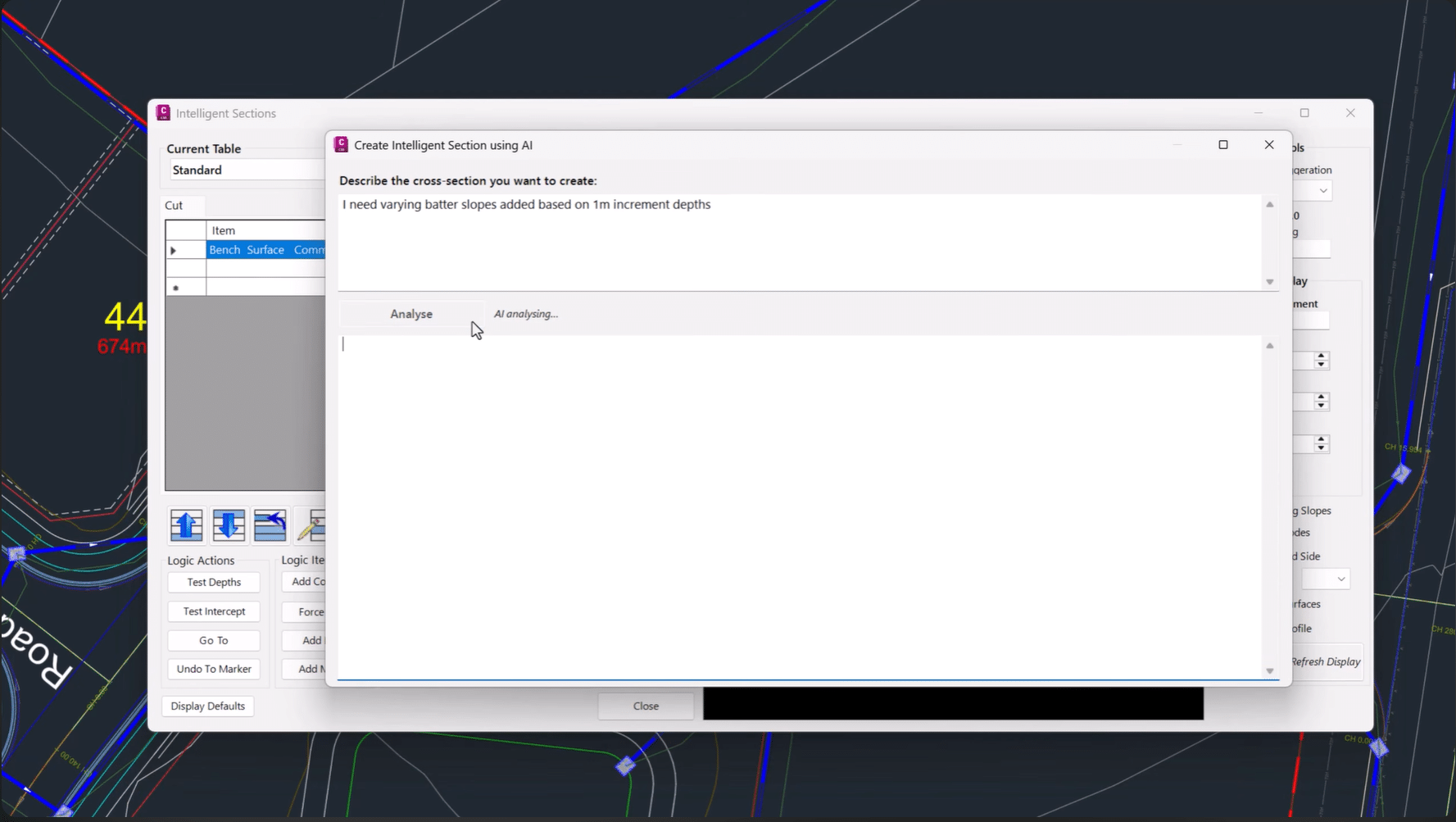
Designing conditional cross sections has traditionally been one of the more time-consuming aspects of road and corridor modelling. Configuring decision tables, defining design rules, and ensuring all conditions are met can be a complex and iterative process. However, with the introduction of Intelligent Sections AI in Civil Site Design and Corridor EZ, this process is revolutionised.
Intelligent Sections AI leverages advanced algorithms to automate the creation of conditional cross sections, significantly reducing design time and improving accuracy. This innovative feature understands design intent from natural language inputs, allowing engineers to describe their requirements in plain English rather than wrestling with intricate rule sets.
The screen shots and videos below show the functionality operating on Civil Site Design. The same functionality is accessible in Corridor EZ.
Key Benefits of Intelligent Sections AI:
- Time Savings: Automates repetitive tasks, freeing up engineers to focus on more critical design aspects.
- Enhanced Accuracy: Minimises human error through AI-driven rule application and validation.
- Improved Design Quality: Ensures all design conditions are met consistently, leading to higher quality outputs.
- User-Friendly Interface: Natural language processing makes it easier for engineers to define complex conditions without extensive training.
- Seamless Integration: Works within existing Civil Site Design and Corridor EZ workflows, ensuring a smooth transition.
How it Works:
Intelligent Sections AI interprets natural language commands to generate and apply design rules. For example, an engineer can simply type: “If the cut is greater than 2 meters, apply a 1:4 batter, otherwise apply a 1:2 batter.” The AI then translates this command into the appropriate design parameters and applies them across the entire corridor.
This capability extends to various complex scenarios, including:
- Defining multiple batter conditions based on cut and fill depths.
- Applying different subgrade materials based on soil conditions.
- Creating variable shoulder widths depending on road classification.
- Integrating drainage solutions based on rainfall data and terrain.
Example Scenarios:
Consider a project where a road passes through varying terrain. Traditionally, this would require manual adjustments to cross sections at numerous chainages. With Intelligent Sections AI, the system automatically detects changes in terrain and applies the predefined conditional rules, such as:
- “If fill depth exceeds 3 meters, introduce a 2-meter wide berm.”
- “Where the road crosses a watercourse, implement a culvert with specific dimensions.”
These rules are applied dynamically, ensuring design consistency and compliance with engineering standards.
Future Implications:
The introduction of Intelligent Sections AI marks a significant step forward in civil engineering design. It not only streamlines current workflows but also opens up possibilities for more sophisticated and adaptive design processes. As AI technology continues to evolve, we can expect even more intelligent automation, further enhancing productivity and design quality in infrastructure projects.
Intelligent Sections AI is more than just a feature; it’s a paradigm shift in how civil engineers approach corridor modelling, making complex designs simpler, faster, and more accurate.